April 13, 2020
Guitar Pedals
1) Research at least 3 different analog guitar pedal manufacturers. Here is a huge list if you need it. Try to look at big brands who manufacture a lot of pedals as well as boutique companies that have smaller lines.
I looked at:
- Area51tone’s The Alienist
- Dandelectro’s Spring King Reverb
- Boss’s BD-2 Blues Driver
- Ibanez Tube Screamer
1a) What do you like and dislike about them? What types of pedals do you find interesting, and that you wish you could learn more about? Try to pick out analog effects and not digital ones.
I found that what first drew me to a pedal was the style of it and the appearance (boutique shop pedals especially). I was drawn in by the style and then I would explore what the pedals did. I picked out a bunch of pedals that happened to be fuzz/drive pedals. It was interesting how the different companies set up the pedal and how it functioned (what types of switches/pots were used). Id like to learn more about how some pedals transitioned from analog to digital and how effects could be done in both but might be easier digitally (differences between creating an analog reverb with a spring and a digital reverb).
1b) Can you describe any overall differences in approach that you see in what bigger companies (Boss, MXR, Ibanez, TC Electronics) are making, and what smaller “boutique” companies (for example – Death By Audio, ZVex, Fairfield Circuitry, Walrus Audio, T-Rex) are making?
The big companies keep their outside pedal design simple. Most of the pedals are a single color with the needed switches and pots on the top of the pedal. The boutique pedals combine handmade circuits with a more unique outside that draws the buyer in. All of the boutique companies’ pedals that I was looking at are hand made wherever the company is based out of while bigger companies have larger separate factories to mass produce pedals. The boutique companies are manufacturing more specific or unique pedals (whether that is in what the actual pedal does or the design aspect of it) instead of a one size fits all design and “generic” effect.
1c) The possibilities for guitar pedals and analog effects are literally endless. See if you can find a pedal that has a sound, controls, or features that are undeniably different from anything else. Post a link, photo, or video demo of it and explain what’s unique about it.
Design wise, the Dr. No Effects Skull Fuzz Original is unlike any pedal I’ve ever seen. The function is the same as other fuzz pedals however the pedal is a skull instead of a “normal pedal” design. There is a latching button on the top to trigger the fuzz and the eyeballs function a volume knob and a knob to control the fuzz. There is also a switch on the side of the skull to vary the fuzz.
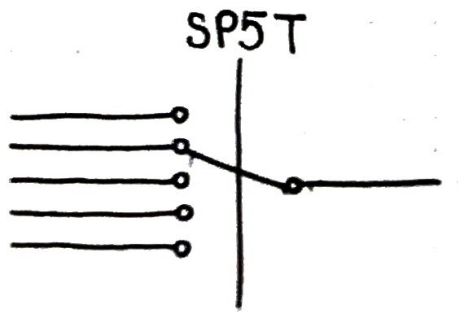
2) Draw a diagram for a SP5T switch. What kind of switch is this?
An SP5T switch has a single pole and 5 throws.
3) Explain the difference between a momentary button vs a latching button. What kind of application could you use each type for?
A momentary button engages the circuit when it is pressed down and disconnects when it is not pressed down. Momentary buttons are good for creating a scale with an oscillator and you use a bunch of different momentary keys so when you press one it only plays that note for as long as it’s pressed. When a latching button is pressed it clicks and it will engage the circuit until it is pressed again. Latching buttons are good for pedals when you want to engage the effect for a sustained period of time until you press the button again.

